Investing in automated perimeter access is one of the most effective ways to instantly elevate your property’s security, boost curb appeal, and increase overall real estate valuation. However, embarking on a professional automatic gate installation involves much more than simply picking an attractive design out of a catalog.
An automatic gate is a heavy, active mechanical structure that operates outdoors under constant environmental stress. Choosing the wrong configuration can lead to operational headaches, premature motor failure, or frequent repair bills. A successful project requires balancing structural realities, spatial constraints, traffic volume, and access logic.
This comprehensive engineering and design guide walks you through every critical decision point of the selection and preparation process, ensuring you choose the perfect automated entry system for your home or commercial facility.
1. Analyze Your Spatial Boundaries and Topography
The layout of your driveway and the surrounding topography dictate the mechanics of your installation. Before looking at materials or aesthetics, you must measure the physical clearance zone available when the gate is fully open.
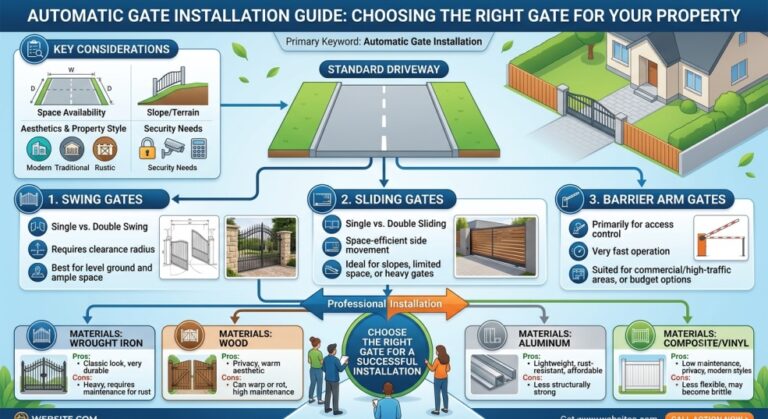
Swing Gates vs. Slide Gates: Spatial Demands
-
Swing Gates: These operate like standard interior doors, swinging inward toward the property or outward toward the street (though inward-swinging is standard practice to avoid blocking public rights-of-way). A swing gate requires a completely clear, semi-circular path of travel equal to the width of the gate leaf.
-
Slide Gates: These move parallel to your fence line or boundary wall. They are the ideal solution for properties with short driveways where a swinging leaf would hit a parked vehicle, or where the driveway immediately slopes upward toward the house.
The Slope Challenge
If your driveway climbs a steep hill as you enter, a standard inward-swinging gate will strike the pavement before completing its cycle. While specialized uphill hinges can compensate for minor inclines, a steep grade usually forces a choice between an outward-swinging configuration, a sliding mechanism, or a canted track system. Identifying these topographical realities early prevents critical installation errors.
2. Match the Gate Type to Your Daily Operational Flow
Different mechanical layouts excel at different tasks. Selecting the right physical design depends heavily on your specific security goals and how many times the system cycles each day.
Single Swing vs. Bi-Parting (Double) Swing
A single swing gate uses one massive leaf to close off the entire driveway opening. It is highly cost-effective because it requires only a single automatic operator arm and half the low-voltage wiring.
However, a bi-parting double swing gate utilizes two leaves meeting in the center. Double gates require less operational radius depth to open, move faster across the driveway, and present a balanced visual profile perfect for estate entries.
Cantilever vs. Ground-Track Slide Gates
If you opt for a sliding gate, you must choose how it is structurally supported:
-
Ground-Track Systems: These feature a rigid V-track anchored directly into a concrete footing across the driveway. The gate rolls smoothly on internal wheels. While highly stable and cost-effective, the track must be kept completely clear of gravel, leaves, ice, and debris to prevent the gate from derailing.
-
Cantilever Systems: These gates are suspended entirely above the driveway surface, supported by heavy-duty enclosed roller assemblies mounted on offset concrete foundations next to the opening. Because it never touches the ground, a cantilever gate is completely immune to track blockages caused by dirt, snow, or shifting soil. This makes it the absolute gold standard for industrial yards and high-traffic commercial gate solutions.
3. Select the Right Structural Material
The material you choose impacts not only the visual aesthetic of your property but also the overall weight of the structure, the level of wind resistance it encounters, and the long-term maintenance it demands.
Wrought Iron and Heavy Steel
-
Pros: Incredible structural strength, highly secure, timeless luxury appearance.
-
Cons: Heavy weight puts substantial load on operator motors; susceptible to rust if the protective powder-coating is chipped; requires routine painting.
Architectural Aluminum
-
Pros: Naturally rust-resistant, completely immune to corrosion from road salt or moisture, and incredibly lightweight. The reduced physical mass puts less mechanical stress on internal gears, significantly extending the lifespan of your automated opener.
-
Cons: Higher upfront material cost; slightly more flexible than steel under severe physical impact.
Natural Wood
-
Pros: Unmatched privacy and warm, organic aesthetic that complements rustic or Craftsman-style architecture.
-
Cons: Extreme structural weight; acts like a massive sail in high winds, which can trigger motor overload settings. Wood naturally warps, twists, and absorbs moisture over time, requiring routine structural alignment adjustments and sealing.
4. Specify Your Automation Drive System (The Motor)
The motor and gearbox assembly form the mechanical heart of your automatic gate installation. Specifying the wrong motor type or undersizing the horsepower rating will lead to rapid equipment failure.
Linear Arms and Articulated Actuators
For swing gates, linear ram arms use an internal screw-drive or hydraulic piston to pull the gate open. They are sleek, low-profile, and mount directly to the gate post and frame.
Articulated operators use a two-piece jointed mechanical arm. While more visually prominent, articulated arms are incredibly versatile, making them ideal for extra-wide, decorative masonry pillars where a linear arm cannot achieve the correct leverage angles.
Slide Gate Operators
Slide gate motors sit on a concrete pad adjacent to the gate opening. They drive the gate laterally using either a heavy-duty roller chain clamped to each end of the frame or a rigid steel gear rack bolted directly along the lower rail.
Expert Insight: Never size your operator motor based solely on the static weight of your gate leaf. You must factor in environmental drag. A solid wood privacy gate facing high coastal winds requires a significantly heavier industrial-grade motor with robust internal gearboxes compared to an open, decorative iron picket gate of the exact same weight. Our team specializes in precise calculation frameworks during our comprehensive automatic gate installation process to ensure your motor is perfectly paired to your specific environment.
Structural Comparison Matrix: Gate System Specifications
| Gate Type | Ideal Spatial Condition | Best Material Match | Recommended Operator System | Maintenance Profile |
| Single Swing | Deep clearance radius; flat, level driveway pavement. | Aluminum or Open-Picket Iron | Linear Actuator Ram | Low – Fewer moving parts and single motor wiring. |
| Bi-Parting Swing | Limited clearance depth; wide entryway openings. | Ornamental Iron or Steel | Dual Linear Arms or Articulated Operators | Medium – Requires dual-motor synchronization tuning. |
| V-Track Slide | Ample side-clearance; flat terrain; minimal wind resistance. | Steel or Heavy Aluminum | Chain or Rack-and-Pinion Slide Motor | Medium – Track must be swept free of debris regularly. |
| Cantilever Slide | High-traffic commercial sites; unpaved roads; snow/ice zones. | Heavy-Duty Structural Aluminum | Industrial-Grade Slide Operator | Low – Suspended design protects moving parts from dirt. |
5. Architect Your Access Control and Peripheral Logic
A gate is only as secure as the system that commands it. Modern entryways integrate a wide array of credential readers and communications loops to regulate traffic smoothly.
Modern Access Entry Systems
-
Telephone and Video Intercoms: Allow visitors to communicate directly with your smartphone or a central office, enabling you to visually verify their identity and grant access from anywhere in the world.
-
Keypads and Proximity Card Readers: Ideal for staff, residents, or delivery services requiring reliable, standalone access.
-
Long-Range RFID Tags: Mount directly to authorized vehicle windshields, automatically opening the gate as the car approaches—exactly like an express toll lane.
Integrating these technologies seamlessly requires specialized design knowledge to ensure the low-voltage communication signals match your operator’s motherboard configuration perfectly. Explore advanced options through our tailored access control systems to build a secure, user-friendly digital perimeter.
6. Prioritize Mandatory Safety and Entrapment Protection
An automated gate is an incredibly powerful machine. Under strict industry safety standards like UL 325, an automatic gate system cannot legally rely solely on manual vigilance; it must feature active, redundant entrapment protection.
During an installation, technicians install photoelectric eyes near the ground to catch passing pedestrians or pets. Additionally, contact edge sensors can be installed along the leading edges of the frame to reverse the motor instantly if they touch an obstacle.
For high-traffic driveways, burying magnetic vehicle loops beneath the asphalt ensures the gate cannot accidentally close while a car is idling over the track path. Skipping these features during installation creates an unacceptable safety hazard and opens the property owner to significant legal liability.
Frequently Asked Questions (FAQ)
Do I need a concrete building permit for a residential gate installation?
Permit requirements vary significantly depending on local municipal building codes, zoning regulations, and Homeowners Association (HOA) guidelines. Generally, structures that exceed specific heights, anchor deep into structural concrete footings, or sit close to public roads require formal building permits. A professional installer handles these regulatory checks before breaking ground.
Can my existing manual driveway gate be automated?
In many cases, yes. If your current manual gate is structurally sound, perfectly plumb, balances evenly without sagging, and swings or slides smoothly without binding, it can be retrofitted with an automatic operator. However, if the frame is warped or the pillars are sagging, those structural issues must be resolved through professional gate opener repair & replacement services before adding power.
What happens to my automatic gate during a total power outage?
Professionally engineered systems feature an internal battery backup system that automatically takes over during a power failure, providing enough electrical storage to cycle the gate 20 to 100 times depending on weight. Additionally, every system includes a physical manual release key or lever, allowing you to safely disconnect the drive motor and move the gate by hand if needed.
How deep do automatic gate posts need to be set in the ground?
To properly support hundreds of pounds of structural leverage, main gate posts must be set exceptionally deep—typically below your local frost line, or a minimum depth of 3 to 4 feet for standard residential gates. They must be encased in high-strength, steel-reinforced structural concrete to prevent the post from tilting over time under the immense constant leverage of the gate leaf.
What is the average timeframe for a complete automated gate installation?
A standard residential installation typically takes between 2 to 5 working days of on-site labor. This timeline is split between setting the structural posts and concrete foundations (which require time to cure properly), mounting the physical gate leaves, running underground low-voltage electrical conduits, and performing final programming and safety calibration tests.
Summary of Key Installation Takeaways
-
Analyze Your Space First: Driveway depth, lateral clearance, and terrain slope dictate whether a swing or slide mechanism is functionally viable.
-
Material Weights Matter: Lightweight materials like architectural aluminum reduce mechanical wear on your motor gears compared to massive wood or iron.
-
Account for Environmental Drag: Always size your operator motor based on both total weight and wind load factors to prevent premature burnouts.
-
Safety Compliance is Mandatory: Active entrapment protection like photo eyes and contact edges are critical to protect your family, visitors, and vehicles.
-
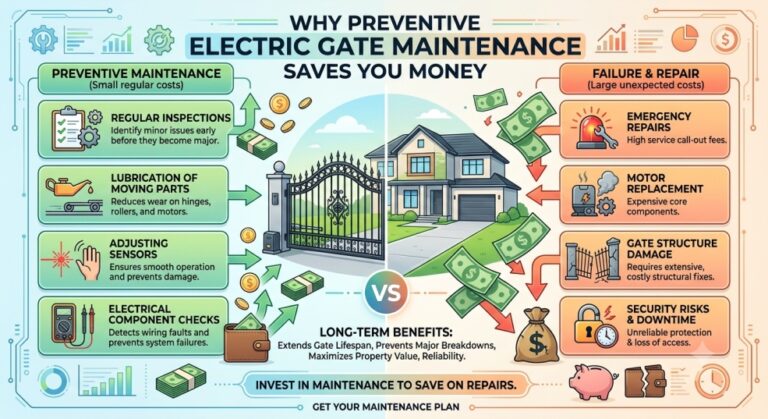
Proactive Care Extends Lifespan: Protecting your investment begins on day one. Setting up a recurring electric gate maintenance program keeps your mechanical and electrical components calibrated for years to come.
Ready to Elevate Your Property’s Perimeter?
An automatic gate is a complex, long-term upgrade that demands precision engineering, proper structural alignment, and secure low-voltage programming. Cutting corners during the initial installation invariably leads to persistent operational glitches and expensive repairs down the road.
Partner with the professional team at BMS Automatic Gates to ensure your installation is handled flawlessly from initial site analysis to final safety validation. We bring decades of specialized expertise to residential layouts and advanced commercial gate solutions.
Contact BMS Automatic Gates Today to schedule an on-site design consultation and receive a precise estimate for your custom automatic gate system.