An automatic gate is one of those modern conveniences you completely take for granted—right up until the moment it refuses to open, leaving your car idling in the driveway or halting your commercial delivery schedule. Whether it safeguards a private residential property or regulates heavy traffic at an industrial facility, an automatic gate functions as a complex intersection of heavy structural engineering, high-voltage electrical power, and sensitive computerized access logic.
When a component begins to fail, it rarely happens in complete silence. The system will drop subtle clues, abnormal noises, or structural hitches long before a total mechanical breakdown occurs. Ignoring these minor warnings can transform a quick calibration fix into an incredibly expensive structural replacement.
This comprehensive guide breaks down the seven definitive warning signs that indicate your system requires professional automatic gate repair, how to troubleshoot basic issues safely, and how modern diagnostic frameworks ensure your property remains secure and accessible.
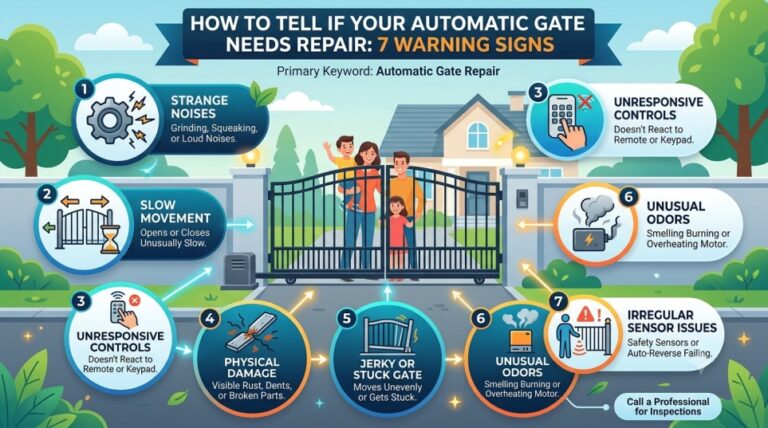
1. Unfamiliar or Loud Noises During Operation
An electric entryway should operate with a predictable, rhythmic hum. While no heavy mechanical system is entirely silent, a sudden shift in the acoustic profile of your gate is one of the most reliable indicators of internal distress.
Squeaking, Grinding, and Scraping
If you hear a harsh metal-on-metal grinding sound, the physical hardware is likely experiencing extreme friction. For slide gates, this usually points to worn-out roller bearings or a track clogged with debris, gravel, or rusted metal shards. For swing gates, grinding typically indicates that the internal heavy-duty hinges have dried out, lost their lubrication, or structurally shifted under the weight of the gate leaf.
Clicking, Thumping, or Chattering
A rapid clicking or chattering sound during the start or end of a cycle usually points to an electrical or drivetrain issue. It often signifies a slipping chain, a worn-out internal gear inside the gearbox, or a failing relay switch in the control box trying desperately to send voltage to the motor.
Expert Insight: Never attempt to quiet a grinding gate by blindly spraying standard WD-40 onto the tracks or chains. Standard WD-40 is a degreaser and solvent, not a heavy-duty lubricant; it will wash away residual grease, attract dirt like a magnet, and accelerate internal component wear. Instead, a technician specializing in comprehensive electric gate maintenance will use dedicated lithium-based or marine-grade silicone lubricants after thoroughly clearing physical contaminants from the assembly.
2. Delayed, Intermittent, or Jerky Movement
When you press your remote transmitter or enter your PIN, the response from your gate should be smooth and immediate. If your gate hesitates, halts midway through its path, or moves with a stuttering, jerky motion, the system is actively fighting internal resistance.
Jerky movement is frequently caused by a physical misalignment in the track or a bent structural frame. When the gate hitches, the motor has to draw significantly higher electrical current to force the gate past the obstruction. This structural strain triggers the internal safety obstruction settings, causing the system to stall or reverse prematurely. If left unaddressed, this constant power surging will rapidly overheat and burn out the internal motor windings, turning a straightforward track adjustment into a full-scale motor replacement.
3. The Gate Fails to Stay Open or Closed (Ghosting)
Few things are more frustrating—or alarming for property security—than a gate that exhibits a mind of its own. “Ghosting” occurs when a gate opens or closes entirely on its own without any user command, or flatly refuses to remain in its designated limit position.
This eerie behavior is rarely supernatural; it is almost always driven by two distinct root causes:
-
Component Misalignment: Over time, ground shifting, vehicle impacts, or natural soil settling can cause a gate post to tilt by just a fraction of an inch. If a swing gate is slightly out of plumb, gravity will naturally pull the heavy leaf open or closed on its own once the mechanical brake releases.
-
Electrical or Signal Interference: Water intrusion inside the external control box can bridge electrical traces on the motherboard, mimicking an active “open” command. Alternatively, localized radio frequency (RF) interference from nearby military bases, airport radar, or even a neighbor’s failing garage door opener can cross signals with your receiver.
If your automated entrance opens unexpectedly at midnight, your physical security perimeter is compromised. This requires a dedicated diagnostics layout to isolate the faulty component, which is a standard part of targeted automatic gate repair protocols.
4. Misalignment, Sagging, or Dragging Components
A perfectly balanced gate should float evenly across its path of travel. Because these systems handle hundreds of pounds of steel, wood, or wrought iron, structural balance is absolutely critical to the longevity of the automated opener.
How to Spot a Sagging Gate
Step back and look at your gate while it is fully closed.
-
Are the top rails perfectly horizontal and aligned with each other?
-
Is there an even, uniform gap between the gate leaves or between the gate and the latch post?
-
Are there visible scrape marks scored into the asphalt or concrete beneath the path of travel?
If a gate leaf drags along the driveway surface, the physical load placed on the mechanical operator increases exponentially. Automatic openers are designed to move balanced loads; they are not built to hoist or drag structural weight across the ground. A dragging gate will quickly strip internal gears, snap drive chains, or shear off the mounting brackets connecting the operator arm to the gate frame.
5. Faulty Safety Sensors and Photo Eye Malfunctions
Modern safety standards mandate that automated gate loops and systems feature active entrapment protection systems. The most common form is a pair of photoelectric safety eyes mounted near the base of the gate posts. These sensors project an invisible infrared beam across the driveway; if that beam is broken by a vehicle, pet, or human, the gate must immediately stop and reverse to prevent crushing injuries.
Warning Signs of Photo Eye Failure:
-
The gate opens perfectly but completely refuses to close.
-
The main control board displays an active, unbroken error light or emits continuous warning beeps.
-
The gate ignores an actual physical obstruction, creating an incredibly dangerous safety hazard.
Photo eyes are highly sensitive to environmental factors. Dirt buildup on the optical lenses, spiderwebs woven across the casing, or physical brackets bent out of alignment by a weed trimmer can break the beam. If a thorough cleaning of the lenses doesn’t restore smooth operation, the internal circuitry may have suffered a voltage surge or water damage, requiring specialized replacement.
6. Delayed Response or Complete Access Control Failure
Sometimes the mechanical structure of the gate is flawless, but the brain of the system is failing. If you notice a distinct, multi-second lag between pressing your remote and the gate initiating its cycle, or if specific access methods fail entirely, your peripheral control system is breaking down.
Automated entryways rely on intricate data pathways. An issue could stem from a dying battery in your remote transmitter, a corroded hardwired connection inside a telephone entry system, or a fried loop detector buried beneath your concrete driveway.
For commercial properties regulating hundreds of daily users, a failure in the credential reader system can back up traffic onto public roads within minutes. Isolating these digital and low-voltage issues requires specialized expertise in advanced access control systems to safely trace the communication fault without damaging the primary logic board.
7. Visible Physical Damage, Rust, or Fluid Leaks
A weekly visual inspection of your gate hardware can reveal structural failures before they trigger an operational emergency. Physical wear manifests differently depending on your system’s design.
Hydraulic Fluid Leaks
Many heavy-duty commercial swing gate operators use self-contained hydraulic rams. If you spot oil stains on the driveway beneath the operator arm or notice a greasy film accumulating along the chrome piston rod, the internal hydraulic seals have failed. Once the fluid drops below a critical level, the system will lose operational pressure, leading to erratic movement or complete mechanical lockup.
Rust and Material Fatigue
Rust is the structural enemy of automatic gates. On iron or steel gates, check the structural weld points where the operator brackets meet the frame. If rust eats through these critical structural seams, the immense torque generated by the motor can rip the brackets completely out of the gate frame during a cycle, causing catastrophic damage. On slide gates, inspect the main drive chain; a rusted, stiff chain will skip across the drive sprocket, putting severe shock loads directly into the motor gearbox.
Diagnostic Matrix: Causes, Symptoms, and Action Items
| Observed Warning Sign | Most Likely Root Cause | Risk Level | Recommended Resolution Path |
| Harsh grinding or scraping noises | Bone-dry hinge pins, worn-out internal bearings, or tracking debris. | Medium | Clean tracks thoroughly; schedule professional mechanical lubrication and bearing inspection. |
| Gate moves in a jerky, stuttering pattern | Structural track distortion, bent gate frame, or severe physical obstruction. | High | Immediately check for track blockages. Stop using the gate if it continues to stutter to avoid burning out the motor. |
| Gate opens/closes entirely on its own (Ghosting) | Water pooling in the control box, structural post lean, or RF signal interference. | Critical | Shut off the main breaker to secure the property. Request emergency troubleshooting for the motherboard. |
| Gate leaf sags or visible scrapes on the ground | Deteriorated hinge welds, undersized structural posts, or foundational settling. | High | Structural re-leveling and welding reinforcement required. Avoid operating to prevent bracket failure. |
| Gate opens but refuses to close | Blocked, dirty, or completely fried photoelectric safety eyes. | High | Clean optical lenses. Verify alignment indicator lights on the sensors. |
| Total operational silence upon command | Blown electrical fuse, tripped main breaker, or complete backup battery failure. | Low | Check your home or facility electrical panel breaker. If the breaker trips again instantly, call a technician. |
Why DIY Automatic Gate Repair Can Be Dangerous
When a gate malfunctions, it is incredibly tempting to grab a toolkit and attempt a fast fix. However, automatic entryways are inherently unique because they combine massive structural weight with automated physical force and high-voltage electricity. Attempting to repair complex components without professional training introduces several severe risks.
The Threat of Torsion Spring and Counterweight Tension
Many vertical pivot gates or heavy overhead barrier arms rely on high-tension springs or internal counterweights to offset their physical weight. These components store immense mechanical energy. A single slip of a wrench can instantaneously release that stored energy with enough physical force to cause severe injury or property damage.
High-Voltage Electrical Hazards
The main power drop feeding your gate operator typically runs on standard 120V or 240V alternating current. If you open the primary control enclosure without isolating the correct upstream breaker, or if you accidentally touch a charged capacitor, you risk severe electrical shock. Furthermore, improper wiring during a DIY fix can easily short-circuit and ruin a $500 main logic board in a fraction of a second.
Complex Regulatory Liability Standards
In many jurisdictions, automated gates must comply with strict safety standards, such as UL 325 and ASTM F2200. These regulations govern allowable gate speeds, mandatory safety clearance intervals, and required dual-entrapment protection sensors. If you modify or repair a gate incorrectly and it subsequently damages a vehicle or causes an injury, you could face substantial legal liability for operating a non-compliant automated system.
Leaving complex diagnostics to a certified team ensures your system is serviced safely, legally, and to exact factory specifications.
What Happens During a Professional Diagnostic Service?
When a certified technician arrives at your property to perform targeted gate opener repair & replacement, they follow a meticulous, multi-point inspection protocol to isolate both the symptom and the true root cause of the failure.
-
Structural & Mechanical Alignment Check: The technician disconnects the automated drive motor entirely to check the gate’s manual operation. They manually slide or swing the gate to feel for tight spots, binding hinges, or track resistance. This isolates mechanical issues from electrical ones.
-
Electrical Voltage and Current Diagnostics: Using a digital multimeter, the technician measures the incoming power supply line, tests transformer output, and analyzes the amp draw of the motor under load. A high amp draw tells the technician right away that the motor is working too hard due to an underlying mechanical bind.
-
Safety Device Calibration: Every safety loop detector, edge sensor, and photo eye undergoes rigorous testing. The technician verifies that the system responds instantly to simulated obstructions and recalibrates the internal force-limit settings on the control board.
-
Component Tuning and Lubrication: Once repairs are complete, the entire drive assembly is adjusted. Chains are tensioned to exact factory clearances, limit switches are fine-tuned for millimeter-precise stopping positions, and moving parts receive application-specific industrial lubricants.
Frequently Asked Questions (FAQ)
How long should a high-quality automatic gate motor last?
With consistent, professional maintenance, a premium residential gate operator typically lasts between 10 to 15 years. In high-cycle commercial settings, lifespan depends heavily on daily usage frequency and environmental exposure, usually ranging from 7 to 10 years before requiring comprehensive internal component rebuilding or full replacement.
Why does my gate open very slowly when the weather gets cold?
Cold temperatures cause structural metal components to contract slightly and increase the viscosity of mechanical grease, making it thick and sluggish. This creates added physical resistance. Additionally, cold weather significantly reduces the chemical efficiency of internal backup batteries, lowering their voltage output and causing the motor to run slower.
Can I manually open my automated gate if the power goes out?
Yes, every professionally installed automatic gate includes a dedicated manual release mechanism. This may be a special key that unlocks the drive sprocket, a mechanical lever that disengages the operator arm, or a manual bypass tool. It is critical to locate this tool and know how to use it safely before an emergency or power outage occurs.
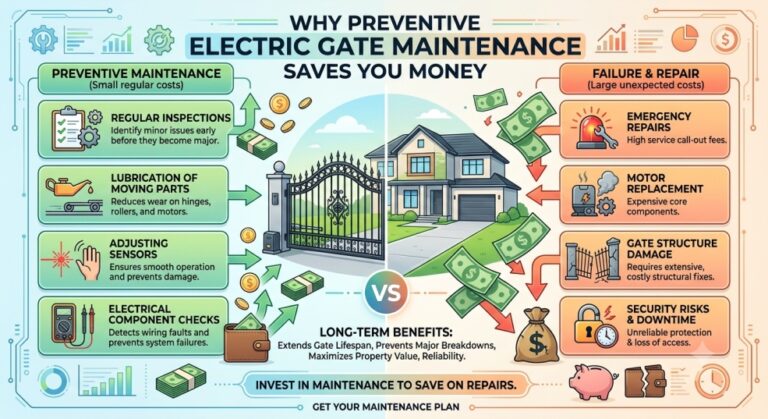
How often should I schedule professional preventive gate maintenance?
For standard residential properties, a thorough inspection and professional lubrication service once a year is usually sufficient. For high-traffic commercial, industrial, or gated residential communities, maintenance should be performed quarterly or semi-annually to catch component wear before it causes a system breakdown.
What should I do if my gate stops moving midway through its cycle?
First, check for any obvious physical blockages in the track path or directly in front of the safety sensors. If the path is clear, turn off the main electrical breaker to the gate operator for 60 seconds, then turn it back on to reset the control board logic. If the gate remains stalled or continues to halt midway, leave the power off and call for professional service to avoid burning out the motor.
Summary of Key Takeaways
-
Acoustic Warnings: Any new grinding, squeaking, or clicking noises are definitive indicators of mechanical friction or electrical component fatigue.
-
Structural Alignment: Sagging or dragging components multiply the workload on your automatic opener, leading to rapid motor failure if not corrected quickly.
-
Safety First: Malfunctioning photo eyes or safety loops pose severe property damage and physical injury risks; they require immediate professional troubleshooting.
-
Environmental Factors: Water intrusion, insect damage, and cold weather are common triggers for electrical glitches and slow gate operation.
-
Professional Expertise: Entrusting your system to specialized professionals protects your safety, maintains your property’s security, and preserves your equipment warranties.
Protect Your Property’s Main Entry Point
If your automated entryway is exhibiting any of these warning signs, do not wait for a total system failure to catch you off guard. Minor operational glitches can rapidly cascade into costly mechanical breakdowns.
Whether you need an immediate emergency diagnostic service or want to safeguard your system with a proactive maintenance plan, the experienced team at BMS Automatic Gates is ready to help. From expert residential troubleshooting to heavy-duty commercial gate solutions, we ensure your perimeter remains safe, functional, and fully secure.
Contact BMS Automatic Gates Today to schedule a comprehensive system diagnostic with a certified gate technician.